Influence of Magnetic Nanoparticle-Modified Sawdust on Dye Removal
Keywords:
Cellulose powder, Dye adsorbent, Magnetite nanoparticles, Sawdust wasteAbstract
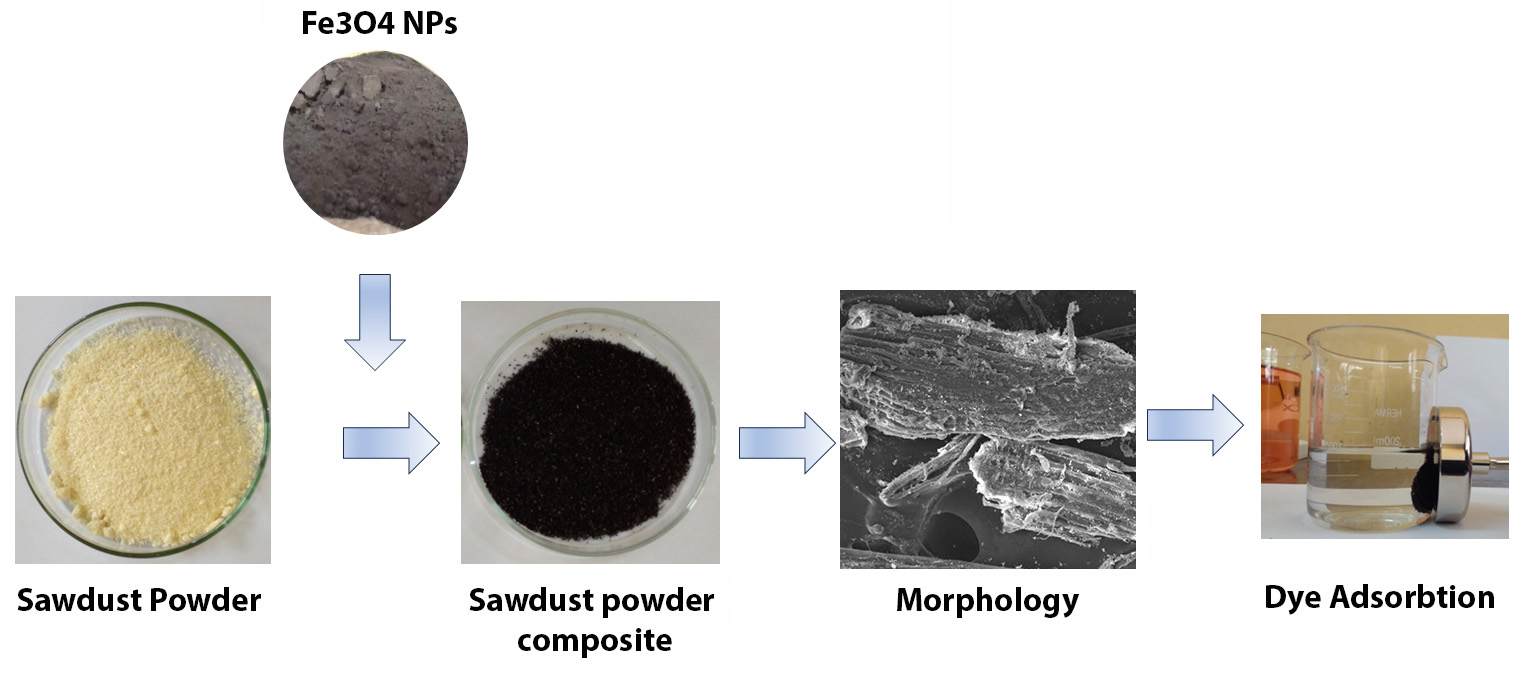
Agricultural industry waste is considered a potential raw material for cellulose sources, providing important advantages. The aim of study is to analyze the properties of sawdust powder waste after being reinforced by magnetic (Fe3O4) nanoparticles. This research used Sengon (Albizia chinensis) wood sawdust waste to produce sawdust cellulose powder. The methods included the crushing process to reduce sawdust waste size, followed by the NaOH and peroxide process. Sawdust powder was reinforced with Fe3O4 nanoparticles at 10, 20, and 30wt%. The magnetic powder was analyzed using XRD, SEM, FTIR, and adsorber test for Congo Red and Methylene Blue dye. The XRD analysis indicates that the sawdust structure was identified as cellulose 1β with the peak of the diffraction angles of 14°, 16°, and 22°. Fe3O4-NPs content reduces the crystallinity of sawdust cellulose powder from 76.05% to 73.31%, while FTIR showed shifts and losses of several cellulose bands that point to interaction between the particles and the cellulose. Incorporating Fe3O4-NPs results in the surface texture of the sawdust powder surface looks rougher. Adsorption tests revealed that Fe3O4-NPs loading enhanced Congo Red removal with a maximum gain of 17.1% (from 56.0% to 65.6%), whereas Methylene Blue removal slightly decreased from 97.0% to 89.9% due to reduced surface hydrophilicity.
References
[1] Widyarani, Wulan DR, Hamidah U, Komarulzaman A, Rosmalina RT, Sintawardani N. Domestic wastewater in Indonesia: generation, characteristics and treatment. Environmental Science and Pollution Research 2022; 29:32397–414. https://doi.org/10.1007/s11356-022-19057-6
[2] Sharma SK. Green Chemistry for Dyes Removal from Wastewater. Hoboken, NJ, USA: John Wiley & Sons, Inc.; 2015. https://doi.org/10.1002/9781118721001
[3] Renu, Agarwal M, Singh K. Heavy metal removal from wastewater using various adsorbents: A review. Journal of Water Reuse and Desalination 2017; 7:387–419. https://doi.org/10.2166/wrd.2016.104
[4] Farhan Hanafi M, Sapawe N. A review on the water problem associate with organic pollutants derived from phenol, methyl orange, and remazol brilliant blue dyes. Mater Today Proc 2020; 31:A141–50. https://doi.org/10.1016/j.matpr.2021.01.258
[5] Rani M, Shanker U. Removal of Organic Dyes by Functionalized Nanomaterials. In: Shanker U, Hussain CM, Rani M, editors. Handbook of Green and Sustainable Nanotechnology: Fundamentals, Developments and Applications, Cham: Springer International Publishing; 2023, p. 1267–98. https://doi.org/10.1007/978-3-031-16101-8_52
[6] Ivanova OS, Edelman IS, Lin C-R, Svetlitsky ES, Sokolov AE, Lukyanenko KA, et al. Core-Shell Fe3O4@C Nanoparticles for the Organic Dye Adsorption and Targeted Magneto-Mechanical Destruction of Ehrlich Ascites Carcinoma Cells. Materials 2023;16. https://doi.org/10.3390/ma16010023
[7] Groeneveld I, Kanelli M, Ariese F, van Bommel MR. Parameters that affect the photodegradation of dyes and pigments in solution and on substrate – An overview. Dyes and Pigments 2023; 210:110999. https://doi.org/10.1016/j.dyepig.2022.110999
[8] Jiang C, Cui S, Han Q, Li P, Zhang Q, Song J, et al. Study on Application of Activated Carbon in Water Treatment. IOP Conf Ser Earth Environ Sci 2019;237:22049. https://doi.org/10.1088/1755-1315/237/2/022049
[9] Barros A, Vecino X, Reig M, Cortina JL. Coagulation and Flocculation Optimization Process Applied to the Sidestream of an Urban Wastewater Treatment Plant. Water (Basel) 2022;14. https://doi.org/10.3390/w14244024
[10] Rashid R, Shafiq I, Akhter P, Iqbal MJ, Hussain M. A state-of-the-art review on wastewater treatment techniques: the effectiveness of adsorption method. Environmental Science and Pollution Research 2021; 28:9050–66. https://doi.org/10.1007/s11356-021-12395-x
[11] Giacobbo A, Bernardes AM. Membrane Separation Process in Wastewater and Water Purification. Membranes (Basel) 2022;12. https://doi.org/10.3390/membranes12030259
[12] Sukmana H, Bellahsen N, Pantoja F, Hodur C. Adsorption and coagulation in wastewater treatment - Review. Progress in Agricultural Engineering Sciences 2021; 17:49–68. https://doi.org/10.1556/446.2021.00029
[13] Research and Market. Cellulose Fiber Market Size, Share & Trends Analysis by Product Type (Natural, Synthetic), by Application (Textile, Hygiene, Industrial), by Regions And Segment Forecasts, 2018 - 2025 n.d.
[14] Haryanto A, Hidayat W, Hasanudin U, Iryani DA, Kim S, Lee S, et al. Valorization of indonesian wood wastes through pyrolysis: A review. Energies (Basel) 2021; 14:1–25. https://doi.org/10.3390/en14051407
[15] Mwango A, Kambole C. Engineering Characteristics and Potential Increased Utilisation of Sawdust Composites in Construction—A Review. Journal of Building Construction and Planning Research 2019; 07:59–88. https://doi.org/10.4236/jbcpr.2019.73005
[16] Rahman NU, Bahadar W, Alam S, Zahoor M, Zekker I, Khan FA, et al. Activated Sawdust-Based Adsorbent for the Removal of Basic Blue 3 and Methylene Green from Aqueous Media. Adsorption Science & Technology 2022; 2022:4551212. https://doi.org/10.1155/2022/4551212
[17] Kheradmand A, Negarestani M, Mollahosseini A, Shayesteh H, Farimaniraad H. Low-cost treated lignocellulosic biomass waste supported with FeCl3/Zn(NO3)2 for water decolorization. Sci Rep 2022; 12:16442. https://doi.org/10.1038/s41598-022-20883-4
[18] Teixeira RA, Lima EC, Benetti AD, Thue PS, Cunha MR, Cimirro NFGM, et al. Preparation of hybrids of wood sawdust with 3-aminopropyl-triethoxysilane. Application as an adsorbent to remove Reactive Blue 4 dye from wastewater effluents. J Taiwan Inst Chem Eng 2021; 125:141–52. https://doi.org/10.1016/j.jtice.2021.06.007
[19] Hussain A, Li J, Wang J, Xue F, Chen Y, Bin Aftab T, et al. Hybrid Monolith of Graphene/TEMPO-Oxidized Cellulose Nanofiber as Mechanically Robust, Highly Functional, and Recyclable Adsorbent of Methylene Blue Dye. J Nanomater 2018;2018:5963982. https://doi.org/10.1155/2018/5963982
[20] Lee KE, Morad N, Teng TT, Poh BT. Development, characterization and the application of hybrid materials in coagulation/flocculation of wastewater: A review. Chemical Engineering Journal 2012;203:370–86. https://doi.org/10.1016/j.cej.2012.06.109
[21] Stefan DS, Bosomoiu M, Stefan M. Methods for Natural and Synthetic Polymers Recovery from Textile Waste. Polymers (Basel) 2022;14. https://doi.org/10.3390/polym14193939
[22] Koshani R, Tavakolian M, van de Ven TGM. Cellulose-based dispersants and flocculants. J Mater Chem B 2020; 8:10502–26. https://doi.org/10.1039/D0TB02021D
[23] Li Z, Gong W, Chen X, Liu L, Meng R, Ding Y, et al. Sustainable cationic cellulose for highly efficient flocculation of Kaolin suspension. Cellulose 2021; 28:11097–108. https://doi.org/10.1007/s10570-021-04211-z
[24] Thangavelu K, Zou L. Evaluating oil removal by amphiphilic MoS2/cellulose acetate fibrous sponge in a flow-through reactor and by artificial neural network. Environ Nanotechnol Monit Manag 2022; 18:100684. https://doi.org/10.1016/j.enmm.2022.100684
[25] Kameya Y, Yabe H. Optical and superhydrophilic characteristics of TiO2 coating with subwavelength surface structure consisting of spherical nanoparticle aggregates. Coatings 2019; 9:547. https://doi.org/10.3390/coatings9090547
[26] Elsacker E, Vandelook S, Damsin B, Van Wylick A, Peeters E, De Laet L. Mechanical characteristics of bacterial cellulose-reinforced mycelium composite materials. Fungal Biol Biotechnol 2021; 8:1–14. https://doi.org/10.1186/s40694-021-00125-4
[27] Yu K, Spiesz EM, Balasubramanian S, Schmieden DT, Meyer AS, Aubin-Tam ME. Scalable bacterial production of moldable and recyclable biomineralized cellulose with tunable mechanical properties. Cell Rep Phys Sci 2021; 2:100464. https://doi.org/10.1016/j.xcrp.2021.100464
[28] Padmanabhan NT, Thomas N, Louis J, Mathew DT, Ganguly P, John H, et al. Graphene coupled TiO2 photocatalysts for environmental applications: A review. Chemosphere 2021;271:129506. https://doi.org/10.1016/j.chemosphere.2020.129506
[29] Yamklang W, Prada T, Bunriw W, Kaeochana W, Harnchana V. Fe3O4-Filled Cellulose Paper for Triboelectric Nanogenerator Application. Polymers (Basel) 2023;15. https://doi.org/10.3390/polym15010094
[30] Xiao YT, Chin WL, Abd Hamid SB. Facile Preparation of Highly Crystalline Nanocellulose by Using Ionic Liquid. Adv Mat Res 2015; 1087:106–10. https://doi.org/10.4028/www.scientific.net/amr.1087.106
[31] Dubey RS, Singh S. Investigation of structural and optical properties of pure and chromium doped TiO2 nanoparticles prepared by solvothermal method. Results Phys 2017; 7:1283–8. https://doi.org/10.1016/j.rinp.2017.03.014
[32] Li X, Li H, Wang X, Xu D, You T, Wu Y, et al. Facile in situ fabrication of ZnO-embedded cellulose nanocomposite films with antibacterial properties and enhanced mechanical strength via hydrogen bonding interactions. Int J Biol Macromol 2021;183:760–71. https://doi.org/10.1016/j.ijbiomac.2021.04.175
[33] Lee CM, Gu J, Kafle K, Catchmark J, Kim SH. Cellulose produced by Gluconacetobacter xylinus strains ATCC 53524 and ATCC 23768: Pellicle formation, post-synthesis aggregation and fiber density. Carbohydr Polym 2015; 133: 270–6. https://doi.org/10.1016/j.carbpol.2015.06.091
[34] Nindiyasari F, Griesshaber E, Zimmermann T, Manian AP, Randow C, Zehbe R, et al. Characterization and mechanical properties investigation of the cellulose/gypsum composite. J Compos Mater 2016; 50:657–72. https://doi.org/10.1177/0021998315580826
[35] YamklangW, Prada T, Bunriw W, Kaeochana W, Harnchana V. Fe3O4-filled cellulose paper for triboelectric nanogenerator application. Polymer 2023; 15(1):94. https://doi.org/10.3390/polym15010094
[36] Bing W, Weijun XU, Jia FU, Wei W, Xueting X. Preparation of two nanometer magnetic flocculants and treatment of slime wastewater Preparation of two nanometer magnetic flocculants and treatment of slime wastewater 2019:0–6. https://doi.org/10.1088/1755-1315/345/1/012015
[37] Kiangkitiwan N, Srikulkit K. Preparation and properties of bacterial cellulose/graphene oxide composite films using dyeing method. Polym Eng Sci 2021; 61:1854–63. https://doi.org/10.1002/pen.25706
[38] Upadhyay S, Parekh K, Pandey B. Influence of crystallite size on the magnetic properties of Fe3O4 nanoparticles. J Alloys Compd 2016; 678:478–85. https://doi.org/10.1016/j.jallcom.2016.03.279
[39] Onyszko M, Markowska-Szczupak A, Rakoczy R, Paszkiewicz O, Janusz J, Gorgon-Kuza A, et al. The cellulose fibers functionalized with star-like zinc oxide nanoparticles with boosted antibacterial performance for hygienic products. Sci Rep 2022; 12:1321. https://doi.org/10.1038/s41598-022-05458-7
[40] Lesiak B, Rangam N, Jiricek P, Gordeev I, Tóth J, Kövér L, et al. Surface study of Fe3O4 nanoparticles functionalized with biocompatible adsorbed molecules. Front Chem 2019;7. https://doi.org/10.3389/fchem.2019.00642
[41] Suciyati SW, Manurung P, Sembiring S, Situmeang R. Comparative study of Cladophora sp. cellulose by using FTIR and XRD. J Phys Conf Ser 2021; 1751:012075. https://doi.org/10.1088/1742-6596/1751/1/012075
[42] Mitić Ž, Nikolić GS, Cakić M, Premović P, Ilić L. FTIR spectroscopic characterization of Cu(II) coordination compounds with exopolysaccharide pullulan and its derivatives. J Mol Struct 2009;924–926:264–73. https://doi.org/10.1016/j.molstruc.2009.01.019
[43] Kamakshi T, Sundari GS, Erothu H, Singh RS. Effect of nickel dopant on structural, morphological and optical characteristics of Fe3O4 nanoparticles. Rasayan Journal of Chemistry 2019; 12:531–6. https://doi.org/10.31788/RJC.2019.1225054
[44] Oh JE, Park N-M. Hydrophilic, transparent, and stretchable film using unmodified cellulose fibers. Mater Lett 2022; 309:131385. https://doi.org/10.1016/j.matlet.2021.131385
[45] Akter M, Bhattacharjee M, Dhar AK, Rahman FBA, Haque S, Ur Rashid TU, et al. Cellulose-based hydrogels for wastewater treatment: A concise review. Gels 2021;7. https://doi.org/10.3390/gels7010030
[46] Yu H, Li Y, Li X, Fan L, Yang S. Highly dispersible and charge-tunable magnetic Fe3O4 nanoparticles: Facile fabrication and reversible binding to GO for efficient removal of dye pollutants. J Mater Chem A 2014; 2:15763–7. https://doi.org/10.1039/C4TA03476G
Downloads
Published
Issue
Section
License
Copyright (c) 2026 Jibril Maulana, Rangga Ega Santoso, Rini Anggi Arista, Alief Muhammad

This work is licensed under a Creative Commons Attribution 4.0 International License.