Cellulose-Based Advanced Materials from Algae for Aquatic Environment Sustainability: Prospects and Challenges
Keywords:
Algae, Cellulose, Advanced material, Sustainable materials, Aquatic environmentAbstract
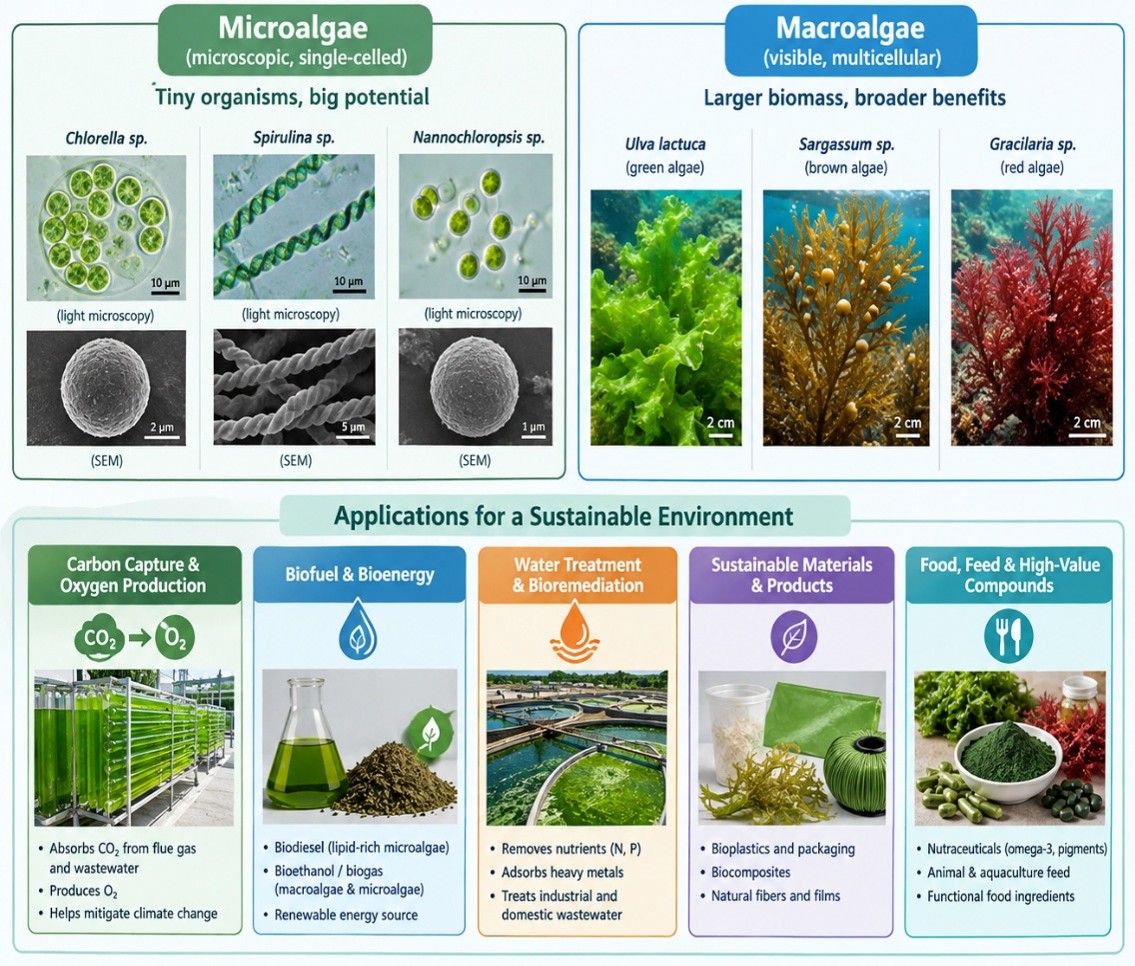
Heavy metal pollution and organic pollutants are serious threats to aquatic ecosystems and require sustainable remediation technologies. Land-based plants and bacterial cellulose have limitations such as deforestation, high processing costs, and scalability issues. Marine macroalgae (e.g. Sargassum sp., Ulva sp. and Cladophora sp.) are a promising alternative because of their rapid growth, high native crystallinity, no lignin content, and no land-use competition. This review emphasizes advanced cellulose materials from algal biomass, and the classifications are divided into microcrystalline cellulose, nanofibrillated cellulose, and cellulose nanocrystals. Extraction methodologies such as chemical, mechanical, and enzymatic processes, and surface functionalizations are critically evaluated with their functional performance in heavy metal adsorption, dye filtration, and membrane separation for wastewater treatment. Important technological and economic bottlenecks, including phyla-dependent structural heterogeneity, preservation of native crystallinity during extraction, and commercial biorefinery feasibility via co-product valuation, are also discussed. Prospective applications of advanced materials from algae for a sustainable environment are also discussed. This paper presents future perspectives on the increase of algal nanocellulose production for sustainable aquatic environment restoration.
References
[1] Huang J, Ma X, Dufresne A, Guang Y. Nanocellulose: From fundamentals to advanced materials. In: Huang J, Dufresne A, Lin N, editors. Nanocellulose: From Fundamentals to Advanced Materials, Weinheim, Germany: Wiley-VCH; 2019, p. 1–486. https://doi.org/10.1002/9783527807437.
[2] Naomi R, Idrus RBH, Fauzi MB. Plant-vs. Bacterial-derived cellulose for wound healing: A review. Int J Environ Res Public Health 2020;17:1–25. https://doi.org/10.3390/ijerph17186803.
[3] Research and Markets. Cellulose Market Forecast Report 2025-2035 - Rising Demand for Biodegradable, Cost-Efficient Cellulose-Based Products and Advancements in Regenerated Cellulose. Https://UkFinanceYahooCom/News/Cellulose-Market-Forecast-Report-2025-104500003Html 2026. https://uk.finance.yahoo.com/news/cellulose-market-forecast-report-2025-104500003.html (accessed October 17, 2026).
[4] Hamad A, Hidayah BI, Solekhah A, Septhea AG. Jurnal Riset Sains dan Teknologi The Potency of Pineapple Skin as a Substrate of Nata de Pina Production 2017;1:9–14.
[5] Wang J, Tavakoli J, Tang Y. Bacterial cellulose production, properties and applications with different culture methods – A review. Carbohydr Polym 2019;219:63–76. https://doi.org/10.1016/j.carbpol.2019.05.008.
[6] Sardjono SA, Suryanto H, Aminnudin, Muhajir M. Crystallinity and morphology of the bacterial nanocellulose membrane extracted from pineapple peel waste using high-pressure homogenizer. AIP Conf Proc 2019;2120. https://doi.org/10.1063/1.5115753.
[7] Luo H, Ao H, Li G, Li W, Xiong G, Zhu Y, et al. Bacterial cellulose/graphene oxide nanocomposite as a novel drug delivery system. Current Applied Physics 2017;17:249–54. https://doi.org/10.1016/j.cap.2016.12.001.
[8] Yanuhar U, Suryanto H, Aminnudin A, Wijaya HW, Maulana J, Caesar NR, et al. Utilization of pineapple peel waste/ZnO nanoparticles reinforcement for cellulose-based nanocomposite membrane and its characteristics. J Polym Environ 2024;32:3749–64. https://doi.org/10.1007/s10924-024-03205-9.
[9] Suryanto H, Syukri D, Faridah A, Yanuhar U, Selvi Binoj J, Nusantara F, et al. Carboxymethyl cellulose films derived from pineapple waste: Fabrication and properties. Mechanical Engineering for Society and Industry 2025;5:50–66. https://doi.org/10.31603/mesi.12789.
[10] Khan Y, Qasim Nasar M, Numan M. Biomimetic Synthesis of Silver Nanoparticles for Breast Cancer Therapeutics and Its Mechanism Bio safety assessments of genetically modified maize View project Green synthesis of Silver Nano particles View project. Int J Nanotechnol Nanomed 2018;3:1–9.
[11] Iravani S, Korbekandi H, Mirmohammadi S V, Zolfaghari B. Synthesis of silver nanoparticles: chemical, physicIravani, S., Korbekandi, H., Mirmohammadi, S. V, & Zolfaghari, B. (2014). Synthesis of silver nanoparticles: chemical, physical and biological methods. Research in Pharmaceutical Sciences, 9(6), 385–406. . Res Pharm Sci 2014;9:385–406.
[12] Wahlström N, Nylander F, Malmhäll-Bah E, Sjövold K, Edlund U, Westman G, et al. Composition and structure of cell wall ulvans recovered from Ulva spp. along the Swedish west coast. Carbohydr Polym 2020;233:115852. https://doi.org/10.1016/j.carbpol.2020.115852.
[13] Jayasooriya N, Gavin C, Craggs R, Gauss C, Glasson CRK, Battershill CN, et al. Properties of cellulose from four freshwater macroalgae cultivated under high nutrient conditions. Cellulose 2026;33:1927–43. https://doi.org/10.1007/s10570-026-06974-9.
[14] Trache D, Tarchoun AF, Derradji M, Hamidon TS, Masruchin N, Brosse N, et al. Nanocellulose: From Fundamentals to Advanced Applications. Front Chem 2020;Volume 8-2020.
[15] Paniz OG, Pereira CMP, Pacheco BS, Wolke SI, Maron GK, Mansilla A, et al. Cellulosic material obtained from Antarctic algae biomass. Cellulose 2020;27:113–26. https://doi.org/10.1007/s10570-019-02794-2.
[16] Amin M, Akbar I. Chapter 10 - Transformation of wastewater-grown algal biomass to industrial biopolymers. In: Mehmood MA, Malik S, Ralph PJ, Bose A, Betenbaugh MJ, editors. Algae Biotechnology, Elsevier; 2026, p. 213–42. https://doi.org/10.1016/B978-0-443-34063-5.00011-8.
[17] Zhao Y, Li J. Excellent chemical and material cellulose from tunicates: Diversity in cellulose production yield and chemical and morphological structures from different tunicate species. Cellulose 2014;21:3427–41. https://doi.org/10.1007/s10570-014-0348-6.
[18] Zanchetta E, Damergi E, Patel B, Borgmeyer T, Pick H, Pulgarin A, et al. Algal cellulose, production and potential use in plastics: Challenges and opportunities. Algal Res 2021;56:102288. https://doi.org/10.1016/j.algal.2021.102288.
[19] Jasuda. Jenis dan Manfaat Rumput Laut di Indonesia. JasudaNet 2014. https://jasuda.net/berita_detail.php?ID=694 (accessed September 21, 2022).
[20] Burton R. Sargassum: Seaweed or Brown Algae – Thompson Earth Systems Institute. Thompson Earth Systems Institute 2018. https://www.floridamuseum.ufl.edu/earth-systems/blog/sargassum-seaweed-or-brown-algae/ (accessed September 21, 2022).
[21] Song T shun, Li T, Tao R, Huang HF, Xie J. CuO/g-C3N4 heterojunction photocathode enhances the microbial electrosynthesis of acetate through CO2 reduction. Science of the Total Environment 2022;818:151820. https://doi.org/10.1016/j.scitotenv.2021.151820.
[22] Kalamkar S, Anthonysamy A, Ashokkumar B, D’souza C, Kadam R, Nadanathangam V. Algal nanocellulose: A potential resource for advanced biomaterials. Cellulose Chemistry and Technology 2025;59:1015–31. https://doi.org/10.35812/CelluloseChemTechnol.2025.59.85.
[23] Azimi B, Sepahvand S, Ismaeilimoghadam S, Kargarzadeh H, Ashori A, Jonoobi M, et al. Application of Cellulose-Based Materials as Water Purification Filters; A State-of-the-Art Review. J Polym Environ 2024;32:345–66. https://doi.org/10.1007/s10924-023-02989-6.
[24] Stepanova M, Korzhikova-Vlakh E. Modification of Cellulose Micro- and Nanomaterials to Improve Properties of Aliphatic Polyesters/Cellulose Composites: A Review. Polymers (Basel) 2022;14:1477. https://doi.org/10.3390/polym14071477.
[25] Suryanto H, Solichin S, Yanuhar U. Natural Cellulose Fiber from Mendong Grass (Fimbristylis globulosa) Fiber structure Mechanical properties. In: Ramawat KG, Ahuja MR, editors. Fiber Plants - Biology, Biotechnology and Applications, Switzerland: Springer International Pub.; 2016, p. 35–52. https://doi.org/10.1007/978-3-319-44570-0.
[26] Puspitasari MP, Puspasari I, Diana D, Yulirohyami Y. Synthesis and Characterization of Microcellulose from Red Algae Gracillaria longissima and Its Effect on the Properties of Composite Films from Avocado Seed Starch. ALCHEMY Jurnal Penelitian Kimia 2025;21:414. https://doi.org/10.20961/alchemy.21.2.97299.414-423.
[27] Trache D, Hussin MH, Hui Chuin CT, Sabar S, Fazita MRN, Taiwo OFA, et al. Microcrystalline cellulose: Isolation, characterization and bio-composites application—A review. Int J Biol Macromol 2016;93:789–804. https://doi.org/10.1016/j.ijbiomac.2016.09.056.
[28] Zuluaga R, Putaux JL, Restrepo A, Mondragon I, Gañán P. Cellulose microfibrils from banana farming residues: Isolation and characterization. Cellulose 2007;14:585–92. https://doi.org/10.1007/s10570-007-9118-z.
[29] Kim MJ, Istianah N, So BR, Kang HJ, Woo MJ, Park SJ, et al. Preparation of High-Solid Microfibrillated Cellulose from Gelidium amansii and Characterization of Its Physiochemical and Biological Properties. J Microbiol Biotechnol 2022;32:1589–98. https://doi.org/10.4014/jmb.2210.10009.
[30] Abdul Khalil HPS, Adnan AS, Yahya EB, Olaiya NG, Safrida S, Hossain MdS, et al. A Review on Plant Cellulose Nanofibre-Based Aerogels for Biomedical Applications. Polymers (Basel) 2020;12:1759. https://doi.org/10.3390/polym12081759.
[31] Sharma A, Tewari R, Rana SS, Soni R, Soni SK. Cellulases: Classification, Methods of Determination and Industrial Applications. Appl Biochem Biotechnol 2016;179:1346–80. https://doi.org/10.1007/s12010-016-2070-3.
[32] Thomas B, Raj MC, Athira BK, Rubiyah HM, Joy J, Moores A, et al. Nanocellulose, a Versatile Green Platform: From Biosources to Materials and Their Applications. Chem Rev 2018;118:11575–625. https://doi.org/10.1021/acs.chemrev.7b00627.
[33] Hillscher LM, Höfler M V, Gutmann T, Lux C, Clerkin KU, Schwall G, et al. Influence of TEMPO-oxidation on pulp fiber chemistry, morphology and mechanical paper sheet properties. Cellulose 2024;31:3067–82. https://doi.org/10.1007/s10570-024-05748-5.
[34] Song K, Zhu X, Zhu W, Li X. Preparation and characterization of cellulose nanocrystal extracted from Calotropis procera biomass. Bioresour Bioprocess 2019;6:45. https://doi.org/10.1186/s40643-019-0279-z.
[35] Anžlovar A, Kunaver M, Krajnc A, Žagar E. Nanocomposites of LLDPE and surface-modified cellulose nanocrystals prepared by melt processing. Molecules 2018;23:1–14. https://doi.org/10.3390/molecules23071782.
[36] Eichhorn SJ. Cellulose nanowhiskers: Promising materials for advanced applications. Soft Matter 2011;7:303–15. https://doi.org/10.1039/c0sm00142b.
[37] Haafiz MKM, Hassan A, Abdul Khalil HPS, Owolabi AF, Marliana MM, Arjmandi R, et al. Cellulose nanowhiskers from oil palm empty fruit bunch biomass as green fillers. Cellulose-Reinforced Nanofibre Composites: Production, Properties and Applications, Elsevier Inc.; 2017, p. 241–59. https://doi.org/10.1016/B978-0-08-100957-4.00010-3.
[38] Motaung TE, Mtibe A. Alkali Treatment and Cellulose Nanowhiskers Extracted from Maize Stalk Residues. Materials Sciences and Applications 2015;06:1022–32. https://doi.org/10.4236/msa.2015.611102.
[39] Zou X, Wu G, Stagge S, Chen L, Jönsson LJ, Hong FF. Comparison of tolerance of four bacterial nanocellulose-producing strains to lignocellulose-derived inhibitors. Microb Cell Fact 2017;16:229. https://doi.org/10.1186/s12934-017-0846-y.
[40] Torres F, Commeaux S, Troncoso O. Biocompatibility of Bacterial Cellulose Based Biomaterials. J Funct Biomater 2012;3:864–78. https://doi.org/10.3390/jfb3040864.
[41] Chang ST, Chen LC, Lin S Bin, Chen HH. Nano-biomaterials application: Morphology and physical properties of bacterial cellulose/gelatin composites via crosslinking. Food Hydrocoll 2012;27:137–44. https://doi.org/10.1016/j.foodhyd.2011.08.004.
[42] Brown AJ. Brown on acetic ferment. Journal of the Chemical Society, Transactions 1886;49:432–9. https://doi.org/10.1039/ct8864900432.
[43] Yan H, Chen X, Song H, Li J, Feng Y, Shi Z, et al. Synthesis of bacterial cellulose and bacterial cellulose nanocrystals for their applications in the stabilization of olive oil pickering emulsion. Food Hydrocoll 2017;72:127–35. https://doi.org/10.1016/j.foodhyd.2017.05.044.
[44] Tang W, Jia S, Jia Y, Yang H. The influence of fermentation conditions and post-treatment methods on porosity of bacterial cellulose membrane. World J Microbiol Biotechnol 2010;26:125–31. https://doi.org/10.1007/s11274-009-0151-y.
[45] Esa F, Tasirin SM, Rahman NA. Overview of Bacterial Cellulose Production and Application. Agriculture and Agricultural Science Procedia 2014;2:113–9. https://doi.org/10.1016/j.aaspro.2014.11.017.
[46] Rahman MM, Netravali AN. High-performance green nanocomposites using aligned bacterial cellulose and soy protein. Compos Sci Technol 2017;146:183–90. https://doi.org/10.1016/j.compscitech.2017.04.027.
[47] Suryanto H. Analisis struktur serat selulosa dari bakteri. Prosiding SNTT 2017 – Politeknik Negeri Malang, vol. 3, 2017, p. 17–22.
[48] Pawar RR, Lalhmunsiama, Kim M, Kim JG, Hong SM, Sawant SY, et al. Efficient removal of hazardous lead, cadmium, and arsenic from aqueous environment by iron oxide modified clay-activated carbon composite beads. Appl Clay Sci 2018;162:339–50. https://doi.org/10.1016/j.clay.2018.06.014.
[49] Urbina L, Corcuera MÁ, Gabilondo N, Eceiza A, Retegi A. A review of bacterial cellulose: sustainable production from agricultural waste and applications in various fields. Cellulose 2021;28:8229–53. https://doi.org/10.1007/s10570-021-04020-4.
[50] AI-Jawhari IFH. Nanocellulose for Sustainable Future Applications. Handbook of Nanomaterials and Nanocomposites for Energy and Environmental Applications, Springer International Publishing; 2020, p. 1–12. https://doi.org/10.1007/978-3-030-11155-7_16-1.
[51] Yanuhar U, Evanuarini H, Musa M, Suryanto H, Maulana J, Wardani NP, et al. Study of the structure and characterization of membranes reinforced with CuO-NPs/Graphene Oxide using bacterial cellulose extracted from Sargassum sp. for water nanofiltration system. IOP Conf. Ser. Earth Environ. Sci., vol. 1328, 2024. https://doi.org/10.1088/1755-1315/1328/1/012017.
[52] Orabi AH, Abdelhamid AES, Salem HM, Ismaiel DA. New adsorptive composite membrane from recycled acrylic fibers and Sargassum dentifolium marine algae for uranium and thorium removal from liquid waste solution. J Radioanal Nucl Chem 2020;326:1233–47. https://doi.org/10.1007/s10967-020-07403-2.
[53] Yanuhar U, Suryanto H, Amin M, Binoj JS, Casuarina I. Green synthesis of nano-copper oxide using Sargassum sp. functionalized in cellulose acetate membrane for dye adsorption. Glob J Environ Sci Manag 2024;10:1933–50. https://doi.org/10.22034/gjesm.2024.04.26.
[54] Doh H, Lee MH, Whiteside WS. Physicochemical characteristics of cellulose nanocrystals isolated from seaweed biomass. Food Hydrocoll 2020;102:105542. https://doi.org/10.1016/j.foodhyd.2019.105542.
[55] Sucaldito MR, Camacho DH. Characteristics of unique HBr-hydrolyzed cellulose nanocrystals from freshwater green algae (Cladophora rupestris) and its reinforcement in starch-based film. Carbohydr Polym 2017;169:315–23. https://doi.org/10.1016/j.carbpol.2017.04.031.
[56] Paini J, Zaccheria F, Ottolina G, Vineis C, Savino E, Varesano A. Ulvan-Based Electrospun Nanofibres From Water Solutions: Process Conditions and Characterisations. J Appl Polym Sci 2026;143:e58093. https://doi.org/10.1002/app.58093.
[57] Tarchoun AF, Trache D, Klapötke TM. Microcrystalline cellulose from Posidonia oceanica brown algae: Extraction and characterization. Int J Biol Macromol 2019;138:837–45. https://doi.org/10.1016/j.ijbiomac.2019.07.176.
[58] Fuertes-Rabanal M, Rebaque D, Largo-Gosens A, Encina A, Mélida H. Cell walls: a comparative view of the composition of cell surfaces of plants, algae, and microorganisms. J Exp Bot 2025;76:2614–45. https://doi.org/10.1093/jxb/erae512.
[59] Randhawa A, Dutta SD, Ganguly K, Patil T V, Patel DK, Lim K-T. A Review of Properties of Nanocellulose, Its Synthesis, and Potential in Biomedical Applications. Applied Sciences 2022;12. https://doi.org/10.3390/app12147090.
[60] Nagpal L, Arora S. Engineering Cellulose for Regenerative Medicine: Bacterial Cellulose and Beyond. Regen Eng Transl Med 2025. https://doi.org/10.1007/s40883-025-00526-6.
[61] Tai R, Ogura I, Okazaki T, Iizumi Y, Mano H. Algal growth inhibition test with TEMPO-oxidized cellulose nanofibers. NanoImpact 2024;34:100504. https://doi.org/10.1016/j.impact.2024.100504.
[62] Blockx J, Verfaillie A, Deschaume O, Bartic C, Muylaert K, Thielemans W. Glycine betaine grafted nanocellulose as an effective and bio-based cationic nanocellulose flocculant for wastewater treatment and microalgal harvesting. Nanoscale Adv 2021;3:4133–44. https://doi.org/10.1039/d1na00102g.
Downloads
Published
Issue
Section
License
Copyright (c) 2026 Faisal Al Nasser, Mohammed Ali Alnasser, Rashmitha Suresh

This work is licensed under a Creative Commons Attribution 4.0 International License.