Implementation and Evaluation of an Internet of Things Controlled Microbubble Generator System for Catfish Pond Water Quality Management
Keywords:
catfish aquaculture, dissolved oxygen, Internet of Things (IoT), microbubble aeration, water quality monitoring, SDG12Abstract
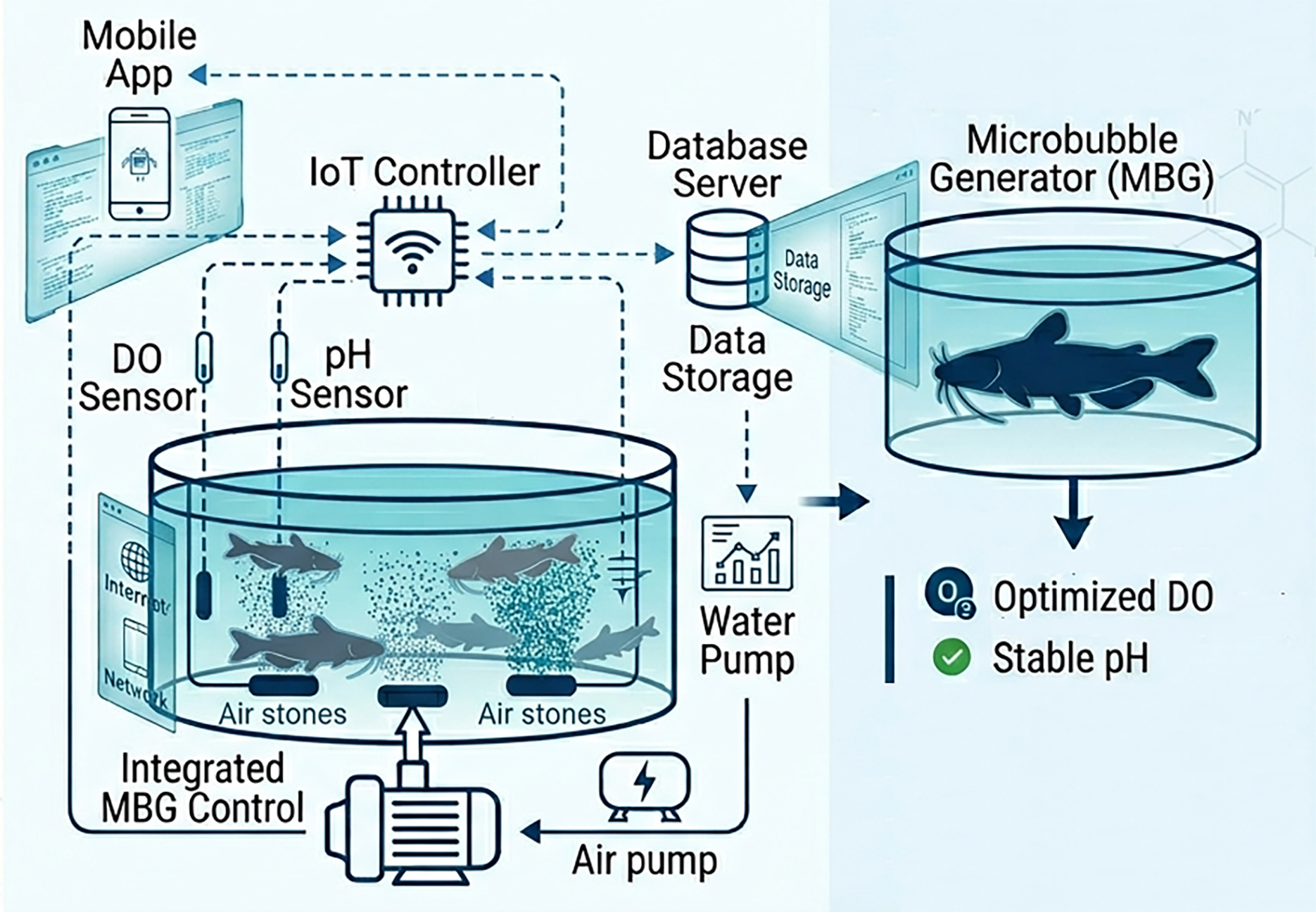
The increasing demand for catfish as a source of animal protein in Indonesia has not been matched by adequate management of pond water quality. In many small-scale aquaculture units, water quality monitoring is still conducted conventionally, resulting in important parameters such as dissolved oxygen and pH often falling outside the optimal range and reducing productivity. This study aims to implement and evaluate the performance of a Microbubble Generator (MBG) system integrated with Internet of Things (IoT) technology for water quality management in catfish ponds. The test location is a catfish pond, Bringin Village, Wajak District, Malang, East Java, Indonesia. The system consists of an MBG unit (pump, aerator, dissolution tank, and distribution pipe) controlled by an IoT module based on dissolved oxygen and pH sensors. Water quality data is monitored in real time via smartphone, while the MBG is operated automatically or manually based on the set thresholds for dissolved oxygen and pH. The implementation results showed that the application of MBG and IoT was able to increase dissolved oxygen levels from 1.71 to 4.97 (190%) mg/L and maintain pond water pH within a relatively stable range (around 8.0–8.4) during the monitoring period, which supports optimal environmental conditions for catfish growth. Furthermore, the automated control system enabled more efficient aeration operation and reduced reliance on manual monitoring. This study demonstrates that the integration of microbubble technology and IoT has the potential to be an affordable solution to improve the sustainability of community-scale catfish farming.
References
[1] Kumar G, Hegde S, Aarattuthodi S, Bosworth B, Sun L, Steensma N. Effect of carryover biomass of channel catfish on production and profitability in intensively aerated multiple-batch system. J World Aquac Soc 2025;56: e13123. https://doi.org/10.1111/jwas.13123
[2] Chandra Segaran T, Azra MN, Piah RM, Lananan F, Téllez-Isaías G, Gao H, et al. Catfishes: a global review of the literature. Heliyon 2023;9. https://doi.org/10.1016/j.heliyon.2023.e20081
[3] Fernando Y, Yamamoto Y, David JW. Navigating the currents of change in U.S. catfish nutrition research. World Aquac Mag 2025; 56:21–25. https://www.was.org/Magazine/2025/01/20/
[4] Ramadhan MR, Rizal A, Hasan Z, Nurhayati A. Demand factors analysis of catfish products (A case study of Mr. Sumar catfish salad stall in Ujungberung Subdistrict, Bandung City, Indonesia). Asian J Fish Aquat Res 2022:10–18. https://doi.org/10.9734/ajfar/2022/v19i330474
[5] Caesar NR, Yanuhar U, Raharjo DKWP, Junirahma NS. Monitoring of water quality in the catfish (Clarias sp.) farming in Tuban Regency. IOP Conf Ser Earth Environ Sci 2021; 718:012061. https://doi.org/10.1088/1755-1315/718/1/012061
[6] Catrawedarma IGNB, Ton S, Pranowo DD, Surahmanto F. Hydrodynamic characteristics of the microbubble dissolution in water using an ejector-type bubble generator. Case Stud Chem Environ Eng 2025; 11:101043. https://doi.org/10.1016/j.cscee.2024.101043
[7] Forhad HM, Uddin MdR, Chakrovorty RS, Ruhul AM, Faruk HM, Kamruzzaman S, et al. IoT based real-time water quality monitoring system in water treatment plants (WTPs). Heliyon 2024;10: e40746. https://doi.org/10.1016/j.heliyon.2024.e40746
[8] Lakshmikantha V, Hiriyannagowda A, Manjunath A, Patted A, Basavaiah J, Anthony AA. IoT based smart water quality monitoring system. Glob Transit Proc 2021; 2:181–6. https://doi.org/10.1016/j.gltp.2021.08.062
[9] Marselina M, Rahmi NA, Nurhayati SA. The water quality of the Upper Citarum: applying the overall index of pollution, Said-WQI, and pollution index methods. Heliyon 2025;11: e41690. https://doi.org/10.1016/j.heliyon.2025.e41690
[10] Hamad FA, Pun K, Alessio B, Najim SA, Ganesan PB, Hughes D. Experimental measurements on the microbubble characteristics and dissolved oxygen (DO) in water using single and twin-Venturi type microbubble generators. Chem Eng Sci 2023; 280:118994. https://doi.org/10.1016/j.ces.2023.118994
[11] Pan Z, Xiao Y, He Y, Kong B, Liang Y. Experimental measurement of the size distribution of microbubbles prepared by reciprocating syringe technique. Chem Eng J Adv 2024; 20:100643. https://doi.org/10.1016/j.ceja.2024.100643
[12] Lu S, Zhao P, Deng Y, Liu Y. Mechanistic insights and therapeutic delivery through micro/nanobubble-assisted ultrasound. Pharmaceutics 2022;14. https://doi.org/10.3390/pharmaceutics14030480
[13] Ramadan MNA, Ali MAH, Khoo SY, Alkhedher M, Alherbawi M. Real-time IoT-powered AI system for monitoring and forecasting of air pollution in industrial environment. Ecotoxicol Environ Saf 2024; 283:116856. https://doi.org/10.1016/j.ecoenv.2024.116856
[14] Abadie T, al Ma Awali SM, Brennan B, Briciu-Burghina C, Tajparast M, Passos TM, et al. Oxygen transfer of microbubble clouds in aqueous solutions – application to wastewater. Chem Eng Sci 2022; 257:117693. https://doi.org/10.1016/j.ces.2022.117693
[15] Suwartha N, Syamzida D, Priadi CR, Moersidik SS, Ali F. Effect of size variation on microbubble mass transfer coefficient in flotation and aeration processes. Heliyon 2020;6:e03748. https://doi.org/10.1016/j.heliyon.2020.e03748
[16] Buvik V, Bernhardsen IM, Figueiredo R V, Vevelstad SJ, Goetheer E, van Os P, et al. Measurement and prediction of oxygen solubility in post-combustion CO2 capture solvents. Int J Greenh Gas Control 2021; 104:103205. https://doi.org/10.1016/j.ijggc.2020.103205
[17] Bok F, Moog HC, Brendler V. The solubility of oxygen in water and saline solutions. Front Nucl Eng 2023; 2:1158109. https://doi.org/10.3389/fnuen.2023.1158109
[18] Hridoy MdAAM, Bordin C, Masood A, Masood K. Predictive modelling of aquaculture water quality using IoT and advanced machine learning algorithms. Results Chem 2025; 16:102456. https://doi.org/10.1016/j.rechem.2025.102456
[19] Shete RP, Bongale AM, Dharrao D. IoT-enabled effective real-time water quality monitoring method for aquaculture. MethodsX 2024; 13:102906. https://doi.org/10.1016/j.mex.2024.102906
[20] Heriyati E, Rustadi R, Isnansetyo A, Triyatmo B, Istiqomah I, Deendarlianto D, et al. Microbubble aeration in a recirculating aquaculture system (RAS) increased dissolved oxygen, fish culture performance, and stress resistance of red tilapia (Oreochromis sp.). Trends Sci 2022;19. https://doi.org/10.48048/tis.2022.6251
[21] Izzaty AN, Yuanita E, Sudirman S, Sarkono S, Al Faris M, Ulfa M. Effect of different treatments during synthesis on physical and chemical properties of bacterial cellulose/chitosan composite film. J Pure App Chem Res 2024; 13:90–101. https://doi.org/10.21776/ub.jpacr.2024.013.02.3349
[22] Samsuri ER, Ganesan P, Jauhari I, Tan GYA, Hamad FA. Reusing biofloc-culture water and microbubble aeration for culturing the white-leg shrimp Litopenaeus vannamei. Aquac Fish 2025; 10:687–95. https://doi.org/10.1016/j.aaf.2024.04.010
[23] Castro JS, Braz-Mota S, Campos DF, Souza SS, Val AL. High temperature, pH, and hypoxia cause oxidative stress and impair the spermatic performance of the Amazon fish Colossoma macropomum. Front Physiol 2020; 11:772. https://doi.org/10.3389/fphys.2020.00772
[24] Mkulo EM, Iddrisu L, Yohana MA, Zheng A, Zhong J, Jin M, et al. Exploring salinity adaptation in teleost fish, focusing on omics perspectives on osmoregulation and gut microbiota. Front Mar Sci 2025; 12:1559871. https://doi.org/10.3389/fmars.2025.1559871
[25] Chen S-M, Chen J-C. Effects of pH on survival, growth, molting and feeding of giant freshwater prawn Macrobrachium rosenbergii. Aquaculture 2003; 218:613–23. https://doi.org/10.1016/S0044-8486(02)00265-X
[26] Lee Y-J, Kang J-K, Jung S-H, Lee C-G, Park S-J, Park J-M, et al. Prediction and optimization of the efficiency and energy consumption of an ammonia vacuum thermal stripping process using experiments and machine learning models. Environ Technol Innov 2024; 34:103610. https://doi.org/10.1016/j.eti.2024.103610
[27] Jin J-H, Wang H-J, Amenyogbe E, Lu Y, Xie R-T, Wang Z-L, et al. Effects of ammonia nitrogen stress on liver tissue structure and physiological indicators, and metabolomic analysis of juvenile four-finger threadfin (Eleutheronema tetradactylum). Front Mar Sci 2025; 12:1549668. https://doi.org/10.3389/fmars.2025.1549668
[28] Meng J, Hu Z, Wang Z, Hu S, Liu Y, Guo H, et al. Determining factors for nitrite accumulation in an acidic nitrifying system: influent ammonium concentration, operational pH, and ammonia-oxidizing community. Environ Sci Technol 2022; 56:11578–88. https://doi.org/10.1021/acs.est.1c07522
[29] Caesar NR, Yanuhar U, Raharjo DKWP, Junirahma NS. Monitoring of water quality in the catfish (Clarias sp.) farming in Tuban Regency. IOP Conf Ser Earth Environ Sci 2021; 718:012061. https://doi.org/10.1088/1755-1315/718/1/012061
[30] Adjovu GE, Stephen H, James D, Ahmad S. Overview of the application of remote sensing in effective monitoring of water quality parameters. Remote Sens (Basel) 2023;15. https://doi.org/10.3390/rs15071938
[31] Chidiac S, El Najjar P, Ouaini N, El Rayess Y, El Azzi D. A comprehensive review of water quality indices (WQIs): history, models, attempts and perspectives. Rev Environ Sci Biotechnol 2023; 22:349–95. https://doi.org/10.1007/s11157-023-09650-7
Downloads
Published
Issue
Section
License
Copyright (c) 2026 The Author(s)

This work is licensed under a Creative Commons Attribution 4.0 International License.