Performance of Zinc Oxide-Enhanced Pineapple-Derived Nanocellulose Nanofilter for Bacterial Reduction in River Water
Keywords:
ZnO nanoparticles, pineapple-derived nanocellulose, nanofiltration, bacterial reduction, river water, Porong RiverAbstract
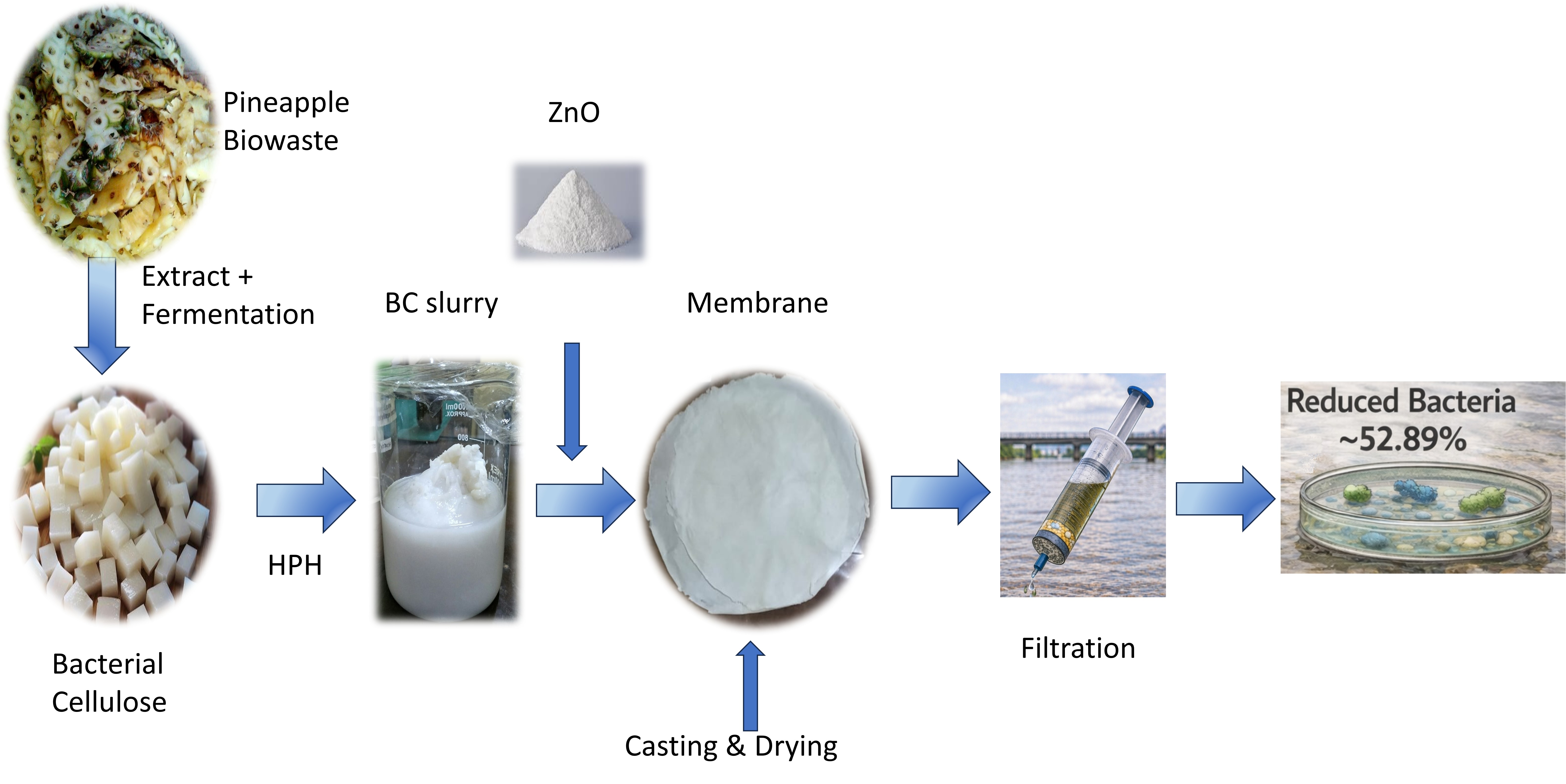
The Porong River is a main river in Sidoarjo, Indonesia, which indicates pollution due to domestic wastewater discharge, industrial activities, and sediment transport associated with the Lapindo mudflow. The pollution leads to microbiological contamination, including pathogenic bacteria. This study aims to investigate the performance of a ZnO-enhanced cellulose-based nanofilter made from pineapple biowaste to reduce the abundance of bacteria in river water. The methods include fabrication of a nanofilter using nanocellulose derived from pineapple peel waste and reinforced with ZnO nanoparticles at concentrations of 0%, 0.25%, 0.5%, 0.75%, and 1%. Water samples were collected from three sampling stations along the river. Bacterial abundance was counted using the Total Plate Count method. Water quality, including temperature, total suspended solids, total dissolved solids, dissolved oxygen, pH, ammonia, nitrate, phosphate, CO₂, and total organic matter, was also analyzed. Results indicate that the water river detected the presence of Bacillus sp., Enterobacter sp., and Salmonella sp., with abundance ranging from (3.67–3.97) × 10³ CFU/mL. One-way analysis of variance indicates that water filtration using a ZnO-reinforced nanofilter significantly reduces bacterial concentrations (F = 10.21, p < 0.05, n = 3). The highest filtration effectiveness was observed at 0.25% ZnO, with an effectiveness of 52.89±11.93%. Increasing ZnO content reduces the effectiveness of the nanofilter, but Tukey analysis indicates that the effectiveness reduction is not different compared to optimal filtration after. It shows that a low concentration of ZnO can be applied to develop a nanofilter with better results. ZnO-enhanced nanofilters are a promising bio–nano-based material for sustainable water treatment and reducing bacterial contamination control in aquatic systems.
References
[1] Anh NT, Can LD, Nhan NT, Schmalz B, Luu T Le. Influences of key factors on river water quality in urban and rural areas: a review. Case Stud Chem Environ Eng 2023; 8:100424. https://doi.org/10.1016/j.cscee.2023.100424
[2] Yanuhar U, Wiratno EN, Suryanto H, Machfuda DR, Caesar NR. Microplastic contamination in the river and its impact on fish health. Glob J Environ Sci Manag 2025; 11:915–40. https://doi.org/10.22034/gjesm.2025.03.04
[3] Kumar A, Kumar P, Raj A, Kisku GC. Assessment of influence of heavy metal, organochlorine pesticide, and bacterial presence on water quality of Gomti river, India. Environ Dev Sustain 2024; 26:1879–901. https://doi.org/10.1007/s10668-022-02790-w
[4] Mendoza-Guido B, Barrantes K, Rodríguez C, Rojas-Jimenez K, Arias-Andres M. The impact of urban pollution on plasmid-mediated resistance acquisition in enterobacteria from a tropical river. Antibiotics 2024;13. https://doi.org/10.3390/antibiotics13111089
[5] Zhang Z, Tamburic B, Le-Clech P, Rao NRH, Chu X, Henderson RK. Impact of bacteria-to-algae cell ratios on organic matter production and bioflocculation of Chlorella vulgaris. J Environ Chem Eng 2025; 13:118927. https://doi.org/10.1016/j.jece.2025.118927
[6] Adetunji CO, Olaniyan OT, Singh KRB, Bodunrinde RE, Inobeme A, Mathew JT, et al. Applications of nanofiltration for wastewater treatment. In: Shah NP, editor. Bio-nano filtration in industrial effluent treatment. Boca Raton: CRC Press; 2023. p. 157–169. https://doi.org/10.1201/9781003165149
[7] Maroufi N, Hajilary N. Nanofiltration membranes types and application in water treatment: a review. Sustain Water Resour Manag 2023; 9:142. https://doi.org/10.1007/s40899-023-00899-y
[8] Sari NLCA, Aminnudin A, Suryanto H, Binoj JS, Bright BM, Jatisukamto G, et al. Characteristics of membranes derived from pineapple biowaste: the effect of nanoclay addition. Appl Sci Eng Prog 2026; 19:1–13. https://doi.org/10.14416/j.asep.2025.06.002
[9] Yanuhar U, Suryanto H, Wijaya HW, Binoj JS, Aminnudin A, Caesar NR, et al. Membrane derived from pineapple biowaste for water filtration in aquaculture environment: effect of zinc oxide nanoparticle. Case Stud Chem Environ Eng 2025; 11:101114. https://doi.org/10.1016/j.cscee.2025.101114
[10] Abebe B, Zereffa EA, Tadesse A, Murthy HCA. A review on enhancing the antibacterial activity of ZnO: mechanisms and microscopic investigation. Nanoscale Res Lett 2020; 15:190. https://doi.org/10.1186/s11671-020-03418-6
[11] Xin Z, He Q, Wang S, Han X, Fu Z, Xu X, et al. Recent progress in ZnO-based nanostructures for photocatalytic antimicrobial in water treatment: a review. Appl Sci 2022; 12:7910. https://doi.org/10.3390/app12157910
[12] Utari ICE, Yanuhar U, Hertika AMS, Suryanto H, Maulana J, Caesar NR, et al. Characterization and performance nanofiltration membranes in water quality for goldfish (Carassius auratus) aquaculture. J Mech Eng Sci Technol (JMEST) 2024; 8:332–44. https://doi.org/10.17977/um016v8i22024p332
[13] Patra JK, Das G, Das SK, Thatoi H. Isolation, culture, and biochemical characterization of microbes. In: A practical guide to environmental biotechnology. Singapore: Springer 2020. p. 83–133. https://doi.org/10.1007/978-981-15-6252-5_4
[14] Astuti LP, Sugianti Y, Warsa A, Sentosa AA. Water quality and eutrophication in Jatiluhur Reservoir, West Java, Indonesia. Pol J Environ Stud 2022; 31:1493–503. https://doi.org/10.15244/pjoes/142475
[15] Liu Y, Zhang B, Zhang Y, Shen Y, Cheng C, Yuan W, et al. Organic matter decomposition in river ecosystems: microbial interactions influenced by total nitrogen and temperature in river water. Microb Ecol 2023; 85:1236–52. https://doi.org/10.1007/s00248-022-02013-9
[16] Abouzied AS, Ofudje EA, Imohiosen FA, Al-Ahmary KM, Al-Mhyawi SR, AlMohamadi H, et al. Adsorptive removal of methylene blue and pharmaceutical effluents using biosynthesized zinc oxide nanoparticles. Sci Rep 2025; 16:3436. https://doi.org/10.1038/s41598-025-33374-z
[17] Helard D, Indah S, Wilandari M. Spatial variation of electrical conductivity, total suspended solids, and total dissolved solids in the Batang Arau River, West Sumatera, Indonesia. IOP Conf Ser Mater Sci Eng 2021; 1041: 012027. https://doi.org/10.1088/1757-899X/1041/1/012027
[18] Singh RP, Sharma K, Mausam K. Dispersion and stability of metal oxide nanoparticles in aqueous suspension: a review. Mater Today Proc 2020; 26:2021–5. https://doi.org/10.1016/j.matpr.2020.02.439
[19] Hundal H, Thevathasan N V, Oelbermann M. Riparian vegetation influences aquatic greenhouse gas production in an agricultural landscape. Ecol Eng 2024;208:107386. https://doi.org/10.1016/j.ecoleng.2024.107386
[20] Ujianti RMD, Novita M, Burhanudin A, Malik M, Mukhtar A, Androva A, et al. Internet of things-based water quality monitoring: a case study in the coastal areas of Semarang city and Kendal Regency, Central Java, Indonesia. Asian J Water Environ Pollut 2025; 22:2–17. https://doi.org/10.36922/AJWEP025110069
[21] Kaya H, Karabacak RB, Çelik Y, Peake J, Watkins S, Sayer R, et al. Application of zincon analysis to investigate the zinc speciation in aqueous media for further understanding of ZnO solubility. Microchem J 2023; 191:108772. https://doi.org/10.1016/j.microc.2023.108772
[22] Ramaekers L, Pinceel T, Brendonck L, Vanschoenwinkel B. Direct effects of elevated dissolved CO2 can alter the life history of freshwater zooplankton. Sci Rep 2022; 12:6134. https://doi.org/10.1038/s41598-022-10094-2
[23] Tumwesigye Z, Tumwesigye W, Opio F, Kemigabo C, Mujuni B. The effect of water quality on aquaculture productivity in Ibanda District, Uganda. Aquac j 2022; 2:23–36. https://doi.org/10.3390/aquacj2010003
[24] Zamel D, Khan AU, Waris A, Ebrahim A, Abd El-Sattar NEA. Nanomaterials advancements for enhanced contaminant removal in wastewater treatment: Nanoparticles, nanofibers, and metal-organic frameworks (MOFs). Results Chem 2023; 6:101092. https://doi.org/10.1016/j.rechem.2023.101092
[25] Zhang Q, Wang M, Mu G, Ren H, He C, Xie Q, et al. Adsorptivity of cationic cellulose nanocrystals for phosphate and its application in hyperphosphatemia therapy. Carbohydr Polym 2021; 255:117335. https://doi.org/10.1016/j.carbpol.2020.117335
[26] Khamis M, Gouda GA, Nagiub AM. Biosynthesis approach of zinc oxide nanoparticles for aqueous phosphorous removal: physicochemical properties and antibacterial activities. BMC Chem 2023; 17:99. https://doi.org/10.1186/s13065-023-01012-2
[27] Duan C, Chen G, Wang Z, Li H, Zhang Z, Liu Y, et al. An ultra-sensitive electrochemical sensing platform based on nanoflower-like Au/ZnO array on carbon cloth for the rapid detection of the nitrite residues in food samples. Food Chem 2024; 437:137892. https://doi.org/10.1016/j.foodchem.2023.137892
[28] Xie Y, Liu X, Wei H, Chen X, Gong N, Ahmad S, et al. Insight into impact of sewage discharge on microbial dynamics and pathogenicity in river ecosystem. Sci Rep 2022; 12:6894. https://doi.org/10.1038/s41598-022-09579-x
[29] Lee C-H, Fang JK-H. Effects of temperature and particle concentration on aggregation of nanoplastics in freshwater and seawater. Sci Total Environ 2022; 817:152562. https://doi.org/10.1016/j.scitotenv.2021.152562
[30] El Mrabate B, Szőri-Dorogházi E, Ahmed Shehab M, Chauhan T, Muránszky G, Sikora E, et al. Widespread applicability of bacterial cellulose-ZnO-MWCNT hybrid membranes. Arab J Chem 2021; 14:103232. https://doi.org/10.1016/j.arabjc.2021.103232
[31] Syukri D, Suryanto H, Kurniawan F, Hari PD, Fiana RM, Rini. Bacterial reduction in river water using nanocellulose membrane from pineapple biomass with ferrous-ferric oxide reinforcement. Glob J Environ Sci Manag 2024; 10:643–56. https://doi.org/10.22035/gjesm.2024.02.14
[32] Suryanto H, Syukri D, Kurniawan F, Yanuhar U, Binoj J, Efendi S, et al. Enhanced dye adsorption and bacterial removal of magnetic nanoparticle-functionalized bacterial cellulose acetate membranes. J Renew Mater 2024; 12:1605. https://doi.org/10.32604/jrm.2024.054047
[33] Al-Badaii F, Al-Khalidy A, Khalid M, Al-Jarfi A, Al-Ansi F, Al-Jarfi A, et al. Green synthesis of zinc oxide nanoparticles using Allium sativum extract: evaluation of antibacterial activity against nosocomial bacteria. TUJNAS 2024; 9:14–9. https://doi.org/10.59167/tujnas.v9i1.2049
[34] Babayevska N, Przysiecka Ł, Iatsunskyi I, Nowaczyk G, Jarek M, Janiszewska E, et al. ZnO size and shape effect on antibacterial activity and cytotoxicity profile. Sci Rep 2022; 12:8148. https://doi.org/10.1038/s41598-022-12134-3
Downloads
Published
Issue
Section
License
Copyright (c) 2026 The Author(s)

This work is licensed under a Creative Commons Attribution 4.0 International License.