Physicochemical Analysis of Porong River Water and Gonadal Maturity of Silver Barb (Barbonymus gonionotus) under Microplastic Exposure
Keywords:
water quality, microplastics, gonadal maturity, barbonymus gonionotus, Porong RiverAbstract
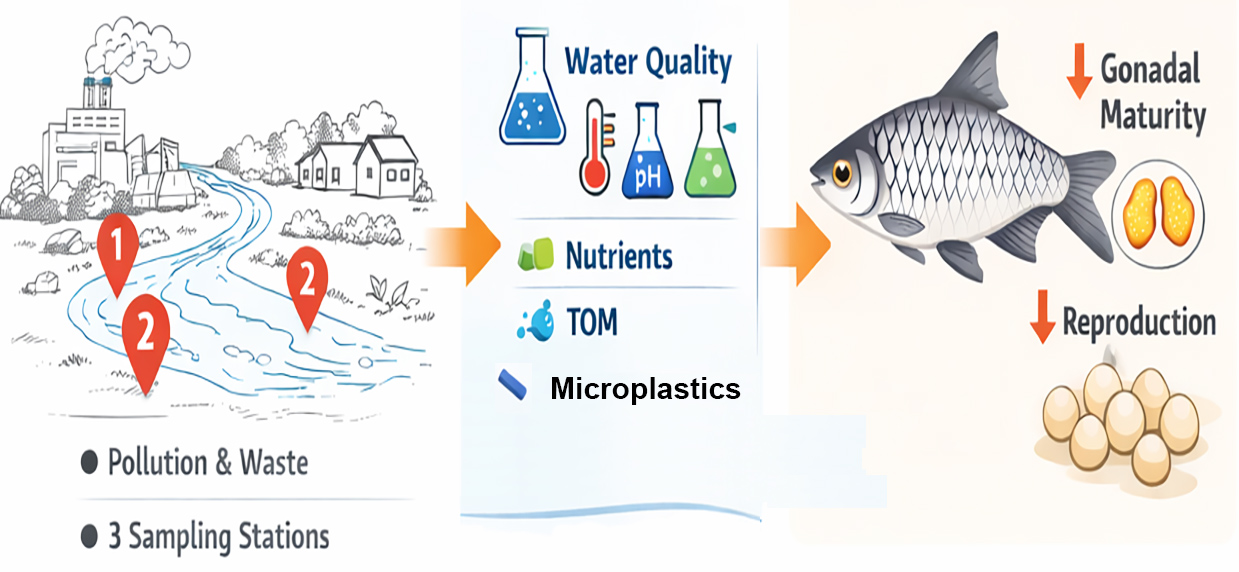
Microplastics are a form of contaminant found in waters, including coastal and river waters. Many rivers were under anthropogenic pressures that influence the water ecosystem. This study aimed to evaluate water quality, the microplastics abundance, and analyze their relationship to gonadal maturity of silver barb (Barbonymus gonionotus). Methods included sample collection at three stations in the Porong River, Sidoarjo, East Java. The sample was observed for water quality, microplastics abundance, and the gonadosomatic index of Silver Barb (Barbonymus gonionotus). The analysis was a descriptive-analytical approach. Results indicate that the quality of the Porong River water was within standard thresholds. The samples are characterized by elevated organic matter (9.84–12.82 mg/L). Nutrient levels, including nitrate (1.09–1.23 mg/L), ammonia (0.05–0.10 mg/L), and orthophosphate (0.18–0.20 mg/L) indicate enrichment. Microplastics were detected at all stations with abundance from 7,467 to 11,200 particles/m³, and were dominated by fragments, fibers, films, and pellets. Descriptive analysis indicates that the water quality of the Porong River still supports fish reproduction, but microplastics have the potential to reduce future reproduction and silver barb populations, so a pollution management strategy is needed. Future management strategies are needed to control pollution and maintain the sustainability of fish populations in the Porong River.
References
[1] Sohns A. River definitions reciprocally define us. River Res Appl 2023; 40:1747–1753. https://doi.org/10.1002/rra.4195
[2] Wang H, He G. Rivers: linking nature, life, and civilization. River 2022; 1:25-36. https://doi.org/10.1002/rvr2.7
[3] D’Avignon G, Gregory‐Eaves I, Ricciardi A. Microplastics in lakes and rivers: an issue of emerging significance to limnology. Environ Rev 2022;3 0:228–44. https://doi.org/10.1139/er-2021-0048
[4] Cássio F, Batista D, Pradhan A. Plastic interactions with pollutants and consequences to aquatic ecosystems: what we know and what we do not know. Biomolecules 2022; 12:798. https://doi.org/10.3390/biom12060798
[5] Wang J, Zheng L, Li J. A critical review on the sources and instruments of marine microplastics and prospects on the relevant management in China. Waste Manag Res 2018; 36:898–911. https://doi.org/10.1177/0734242x18793504
[6] Hakim L, Asmara AJ, Priambodo RY, Wong YJ, Microplastic pollution profile in the Indian Ocean of the Southern Java Island, Indonesia. Environ Chall 2023; 13:100786. https://doi.org/10.1016/j.envc.2023.100786
[7] Yang J, Li H, Ling W, Li Y, Zhang K, Zhang P. Sources, status, and potential risks of microplastics in marine organisms of the Bohai Sea: a systematic review. Toxics 2025;13:400. https://doi.org/10.3390/toxics13050400
[8] Belioka M-P, Achilias DS. How plastic waste management affects the accumulation of microplastics in waters: a review for transport mechanisms and routes of microplastics in aquatic environments and a timeline for their fate and occurrence (past, present, and future). Water Emerg Contam Nanoplastics 2024; 3. https://doi.org/10.20517/wecn.2024.09
[9] Min B-K, Cho C, Cheon H-S, Soh HY, Cho H-S. A study on the distribution of microplastics in the south coast of Korea and Gwangyang Bay. Microplastics 2024; 3:355–72. https://doi.org/10.3390/microplastics3030022
[10] Fajrinia NR, Muzaki FK, Fauziah NF, Aunurohim A, Saptarini D. Characteristics of microplastics in Dusky-Tailed Cardinalfish (Taeniamia macroptera) from natural reef and fish apartment in Pasir Putih Situbondo, East Java, Indonesia. BIO Web Conf 2024; 89:12002. https://doi.org/10.1051/bioconf/20248912002
[11] Zhang L, Li X, Li Q, Xia X, Zhang H. The effects of land use types on microplastics in river water: a case study on the mainstream of the Wei River, China. Environ Monit Assess 2024;196. https://doi.org/10.1007/s10661-024-12430-7
[12] Yahaya T, Ibrahim AB, Kalgo AS, Adewale MK, Emmanuela CC, Abdulkadir B. Microplastics exposure altered hematological and lipid profiles as well as liver and kidney function parameters in albino rats (Rattus norvegicus). Environ Anal Health Toxicol 2024;39:e2024021. https://doi.org/10.5620/eaht.2024021
[13] Nabila A, Patria MP. Microplastics abundance in gills and gastrointestinal tract of Epinephelus fuscoguttatus-lanceolatus at the coastal of Pulau Panjang, Serang, Banten. E3s Web of Conf 2021; 324:01002. https://doi.org/10.1051/e3sconf/202132401002
[14] Shang Y, Wang X, Chang X, Sokolova IM, Wei S, Liu W. The Effect of microplastics on the bioenergetics of the mussel Mytilus coruscus assessed by cellular energy allocation approach. Front Mar Sci 2021;8. https://doi.org/10.3389/fmars.2021.754789
[15] Hafeez S, Qadir A, Aslam M, Aslam HMU, Rehmat MS, Ahmad SR. Environmental risks of microplastics on the spatial and temporal gradient in a river originating from the Western Himalayas. Environ Toxicol Chem 2023; 42:727–39. https://doi.org/10.1002/etc.5559
[16] Erhenhi OH, Enwemiwe VN, Micheal OE, Aghahowa EO, Esiwo E, Obi CC, Omokoro F. Studies on the impact of microplastics in freshwater systems: biota could be vital indicators in Delta State, Nigeria. Uttar Pradesh J Zool 2024; 45:34–44. https://doi.org/10.56557/upjoz/2024/v45i144177
[17] Kameda Y, Yamada N, Fujita E. Source-and polymer-specific size distributions of fine microplastics in surface water in an urban river. Environ Pollut 2021; 284:117516. https://doi.org/10.1016/j.envpol.2021.117516
[18] Moyo S. An enigma: a meta-analysis reveals the effect of ubiquitous microplastics on different taxa in aquatic systems. Front Environ Sci 2022;10. https://doi.org/10.3389/fenvs.2022.999349
[19] Berry K, Epstein HE, Lewis PJ, Hall N, Negri AP. Microplastic contamination has limited effects on coral fertilisation and larvae. Diversity (Basel) 2019;11:228. https://doi.org/10.3390/d11120228
[20] Nowosad J, Kucharczyk D, Targońska K. Enrichment of zebrafish Danio rerio (Hamilton, 1822) diet with polyunsaturated fatty acids improves fecundity and larvae quality. Zebrafish 2017;14:364–70. https://doi.org/10.1089/zeb.2017.1416
[21] Oberdorff T. Time for decisive actions to protect freshwater ecosystems from global changes. Knowl Manag Aquat Ecosyst 2022:19. https://doi.org/10.1051/kmae/2022017
[22] Baptista V, Dias E, Cruz J, Branco MA de C, Vieira S, Teodósio MA. Feeding ecology of Sicydium bustamantei (Greeff 1884, Gobiidae) post-larvae: the “Little Fish” of São Tomé Island. Oceans 2020;1:300–10. https://doi.org/10.3390/oceans1040020
[23] Cordova MR, Iskandar MR, Surinati D, Kaisupy MT, Wibowo SPA, Subandi R. Microplastic occurrence in sub-surface waters of the Indonesian archipelago. Front Mar Sci 2024;11. https://doi.org/10.3389/fmars.2024.1362414
[24] Wang Y, Liu M, Geng X, Zhang Y, Jia R, Zhang Y. The combined effects of microplastics and the heavy metal cadmium on the marine periphytic ciliate Euplotes vannus. Environ Pollut 2022; 308:119663. https://doi.org/10.1016/j.envpol.2022.119663
[25] Wei Q, Hu C-Y, Zhang R-R, Gu Y-Y, Sun A-L, Zhang Z-M. Comparative evaluation of high-density polyethylene and polystyrene microplastics pollutants: uptake, elimination and effects in mussel. Mar Environ Res 2021; 169:105329. https://doi.org/10.1016/j.marenvres.2021.105329
[26] Araújo APC, da Luz TM, Ahmed MAI, Ali MM, Rahman MM, Nataraj B. Toxicity assessment of polyethylene microplastics in combination with a mix of emerging pollutants on Physalaemus cuvieri tadpoles. J Environ Sci 2023; 127:465–82. https://doi.org/10.1016/j.jes.2022.05.013
[27] Carbery M, O’Connor W, Palanisami T. Trophic transfer of microplastics and mixed contaminants in the marine food web and implications for human health. Environ Int 2018; 115:400–9. https://doi.org/10.1016/j.envint.2018.03.007
[28] Hayati A, Yuliarini N, Soegianto A, Widyana H, Rindaputri I, Auliya N. Water quality and fish diversity in the Brantas River, East Java, Indonesia. J Biol Res 2017; 22:44. https://doi.org/10.23869/BPHJBR.22.2.20172
[29] Jensen F, Hukom V, Nielsen R, Nielsen M. An upstream-downstream externality related to water quality: the case of the Porong River in Indonesia. Aquac Econ & Manag 2023; 27:405–440. https://doi.org/10.1080/13657305.2022.2137263
[30] Latef SE, AL-Azawey ASN. Study of effect of some surfactants on water quality of Al-Hilla River, Iraq. Plant Arch 2020; 20:99–105. https://www.plantarchives.org/SPECIAL%20ISSUE%2020-1/18__99-105_.pdf
[31] Kim S, Hyeon Y, Park C. Microplastics’ shape and morphology analysis in the presence of natural organic matter using flow imaging microscopy. Molecules 2023;28:6913. https://doi.org/10.3390/molecules28196913
[32] Wijayanti KAN, Istiqomah I, Murwantoko M. Bacterial abundance and community composition in green, brown and red water from intensive catfish (Clarias sp.) culture ponds in Yogyakarta, Indonesia. Biodiversitas 2021;22. https://doi.org/10.13057/biodiv/d220910
[33] Pratiwi D, Sumiarsa D, Oktavia D, Sunardi S. Water quality influences self-purification in the Cihawuk and Majalaya segments upstream of the Citarum River, West Java, Indonesia. Water (Basel) 2023;15:2998. https://doi.org/10.3390/w15162998
[34] Kader S, Raimi MO, Spalević V, Austin-Asomeji I, Raheem WB. A concise study on essential parameters for the sustainability of lagoon waters in terms of scientific literature. Turk J Agric For 2023, 47: 288-307. https://doi.org/10.55730/1300-011x.3087
[35] Mohamed AS, El-Desoky MA, El-Lahamy AA, Gad NS. Influence of environmental pollutants on water quality and biochemical parameters of fish tissue. Ad Oceanogr & Marine Biol. 2020. 2:1-8. https://doi.org/10.33552/aomb.2020.02.000527
[36] Durojaiye AF, Bamidele NA, Dabo M, Moshood AR. Acute exposure to textile waste water altered the reproduction biomarkers in Clarias gariepinus broodstock. J Perikanan Univ Gadjah Mada 2023; 25:119. https://doi.org/10.22146/jfs.81964
[37] Purnomo T, Sahani K, Wahyudi T. Analysis of carrying capacity of Blekok Beach and Kerapu Beach Situbondo as conservation areas for mangrove, Blekok Bird (Ardidae) and grouper fish cultivation (Epinephelus). E3s Web of Conf 2021; 328:08014. https://doi.org/10.1051/e3sconf/202132808014
[38] Renu N, Rajani P. Rural water quality monitoring and exploring low-cost treatment technology with water hyacinth. Edelweiss Appl Sci Technol 2021; 5:9–13. https://doi.org/10.33805/2576-8484.188
[39] Hidayati NV, Kartikaputri AD, Hernayanti H, Mahdiana A. Water quality and pollution level in Plawangan Barat, Segara Anakan, Cilacap based on pollution index approach. Omni-Akuatika 2023; 19:147–59. http://dx.doi.org/10.20884/1.oa.2023.19.2.1045
[40] Awogbami SO, Solomon OA, Sawyerr HO, Raimi MO. Comparative assessment of seasonal variations in the quality of surface water and its associated health hazards in gold mining areas of Osun State, South-West Nigeria. Adv Environ Eng Res 2023; 04:1–61. https://doi.org/10.21926/aeer.2301011
[41] Abida IW, Asvihana TE. Analysis of water quality status using the storet method in the coastal waters Branta, Pamekasan Regency. J Aquac Dev Environ 2024; 7:448–59. https://doi.org/10.31002/jade.v7i2.2202
[42] Kazour M, Jemaa S, Rakwe ME, Duflos G, Hermabassiere L, Dehaut A. Juvenile fish caging as a tool for assessing microplastics contamination in estuarine fish nursery grounds. Environ Sci Pollut Res 2018; 27:3548–59. https://doi.org/10.1007/s11356-018-3345-8
[43] Zi F, Wang B, Yang L, Huo Q, Wang Z, Ren D. Ecology of saline watersheds: An investigation of the functional communities and drivers of benthic fauna in typical water bodies of the Irtysh River Basin. Biology (Basel) 2024; 13:27. https://doi.org/10.3390/biology13010027
[44] Hertika AMS, Arfiati D, Lusiana ED, Putra RB. Effect of environmental factors on hematology profile of Gambusia affinis caught at Brantas River watershed, Indonesia. F1000Research 2021; 10:1169. https://doi.org/10.12688/f1000research.74117.1
[45] Júnior T, Nisaa AF, Karnaningroem N, Mardyanto MA. The presence of microplastics in Surabaya coastal area and its correlation with conventional water quality parameters. IOP Conf Ser Earth Environ Sci 2024;1414:012038. https://doi.org/10.1088/1755-1315/1414/1/012038
[46] Li J, Mao X, Xing R, Wang Z, Sun Q, Liu H. Microplastics pollution and their potential impact in marine systems: a case study in Shandong Peninsula, China. Acs Est Water 2023; 3:2373–83. https://doi.org/10.1021/acsestwater.3c00087
[47] Daud A, Ishak H, Ibrahim E, Basir B, Birawida AB, Syam RC. Environmental health risk of microplastics due to consumption of fish and shellfish in the coastal area. Iran J Public Health 2024. https://doi.org/10.18502/ijph.v53i7.16049
[48] Zhang Q, He Y, Cheng R, Li Q, Qian Z, Lin X. Recent advances in toxicological research and potential health impact of microplastics and nanoplastics in vivo. Environ Sci Pollut Res 2022; 29:40415–48. https://doi.org/10.1007/s11356-022-19745-3
[49] Adrian MR, Roosmini D. Identification and characteristic of microplastics in sediment and macrozoobenthos of upper Citarum River. E3s Web of Conf 2024; 485:07005. https://doi.org/10.1051/e3sconf/202448507005
[50] Yona D, Sari SHJ, Iranawati F, Bachri S, Ayuningtyas WC. Microplastics in the surface sediments from the eastern waters of Java Sea, Indonesia. F1000Res 2019; 8:98. https://doi.org/10.12688/f1000research.17103.1
[51] Zhou A, Zhang Y, Xie S, Chen Y, Li X, Wang J. Microplastics and their potential effects on the aquaculture systems: A critical review. Rev Aquac 2020;13:719–33. https://doi.org/10.1111/raq.12496
[52] Ma P, Wang M W, Liu H, Chen Y F, Xia J. Research on ecotoxicology of microplastics on freshwater aquatic organisms. Environ Pollut Bioavailab 2019; 31:131–7. https://doi.org/10.1080/26395940.2019.1580151
[53] Yong CQY, Valiyaveettil S, Tang BL. Toxicity of microplastics and nanoplastics in mammalian systems. Int J Environ Res Public Health 2020; 17:1509. https://doi.org/10.3390/ijerph17051509
[54] Montoya D, Rastelli E, Casotti R, Manna V, Trano AC, Balestra C. Microplastics alter the functioning of marine microbial ecosystems. Ecol Evol 2024;14. https://doi.org/10.1002/ece3.70041
[55] Issac MN, Kandasubramanian B. Effect of microplastics in water and aquatic systems. Environ Sci Pollut Res Int 2021; 28:19544–62. https://doi.org/10.1007/s11356-021-13184-2
[56] Hamed M, Martyniuk CJ, Naguib M, Lee J-S, Sayed AE-DH. Neurotoxic effects of different sizes of plastics (nano, micro, and macro) on juvenile common carp (Cyprinus carpio). Front Mol Neurosci 2022; 15:1028364. https://doi.org/10.3389/fnmol.2022.1028364
[57] Valen FS, Widodo MS, Islamy RA, Wicaksono KP, Insani L, Hasan V. Molecular phylogenetic of silver barb Barbonymus gonionotus (bleeker, 1849) (Cypriniformes: Cyprinidae) in Java, Indonesia. IOP Conf Ser Earth Environ Sci, vol. 1036, IOP Publishing; 2022, p. 012011.
[58] Ningrum IP, Sa’adah N, Mahmiah M. Jenis dan kelimpahan mikroplastik pada sedimen di Gili Ketapang, Probolinggo. J Mar Res 2022; 11:785–93. https://doi.org/10.14710/jmr.v11i4.35467
[59] Islam F, Salam MA, Rahman MA, Paul SI, Das TR, Rahman MM. Plant endophytic yeasts Pichia fermentans and Meyerozyma caribbica improve growth, biochemical composition, haematological parameters and morphology of internal organs of premature Barbonymus gonionotus. Aquac Rep 2021;19:100575. https://doi.org/10.1016/j.aqrep.2020.100575
[60] Ayyub H, Budiharjo A, Sugiyarto S. Morphological characteristics of silver barb fish population Barbonymus gonionotus (Bleeker, 1849) from different water locations in Central Java Province. J Iktiologi Indones 2019; 19:65–78. https://doi.org/10.32491/jii.v19i1.378
[61] Munno K, Helm PA, Rochman CM, George T, Jackson DA. Microplastic contamination in great lakes fish. Conserv Biol 2021;36. https://doi.org/10.1111/cobi.13794
[62] Harmon SM, Chen Q, Ma C, Ji M, Yan X, Ji R. The effects of microplastic pollution on aquatic organisms. In: Eddy YZ (ed), Microplastic contamination in aquatic environments. Elsevier: 2024. p. 355–79. https://doi.org/10.1016/B978-0-12-813747-5.00008-4
Downloads
Published
Issue
Section
License
Copyright (c) 2026 Nezya Pramudya Wardani, Moh. Fadjrul Haqqi Muntaha, Nurma Sandra Nirwana, Maharani Hari Nur Pratiwi, Raka Gautama Maxelly

This work is licensed under a Creative Commons Attribution 4.0 International License.